4.1 NUTRIENT LEVELS OF MARSH AS A PROPORTION OF THE WHOLE ECOSYSTEM
Using the data of Table 4.1 and available information for the Peel-Harvey system as a whole, it was found that these fringing marshes account for some 20-30% of the nitrogen and phosphorus (Table 4.1) when sediment values are excluded. The levels are about the same in winter, and exceed in summer, those of the open water. As these calculations are based on vigorous stands, the real pool size will be smaller, and possibly a quarter of these values.
4.2 POSSIBLE PRODUCTIVITY AND NUTRIENT TURNOVER
Mahall and Park (1976) reported net production values as a percentage of above-ground standing crop ranging from 28.7% to 63.9% for Salicornia virginica around San Francisco Bay. These values were derived across a zone of Salicornia. In the absence of local measurements their mean value of 44% was used as a reasonable estimate of what might be occurring here.
When this is applied to the standing crop and nutrient content obtained in this study, a net production of 16,104 tonnes of dry matter is obtained, and this would involve the transfer of 92 tonnes of nitrogen and 13.2 tonnes of phosphorus into new growth each year. Some of this would be recycled within the plant, as probably some 60% of the nitrogen and phosphorus would be recovered by the plant from senescing tissue. Thus about 55 tonnes of N and 7.9 tonnes of P may be exchanged with the environment each year.
Scirpus loses its entire above-ground standing crop each year, surviving as perennating corms. The above-ground standing crop is 2460 tonnes dry weight, and as the material was already senesced when sampled, most corm retrieval had already taken place. Thus the turnover of N and P is about 15 and 2.6 tonnes respectively.
Overall, the turnover of these communities, in above-ground material, is some 70 tonnes N and 10.5 tonnes P. Turnover rates for below-ground material are probably much lower, and the nutrients are less readily exchanged with the open water.
4.3 THE FATE OF DRY MATTER AND NUTRIENTS LOST FROM PLANTS
These materials may be recycled within the marsh through the decay of plant material and nutrient uptake by growing plants; alternatively, they may be washed into the open water by rain in the form of particulate or dissolved material, or transported out by rising and falling water levels as large pieces of plant material, detritus, or in soluble forms. A direct investigation would be interesting, but some observations and speculations are relevant.
At the time of the study, when water levels were low, there was no litter on the ground immediately below plants which would have produced litter the previous season, apart from recently-senesced, above-ground material of Scirpus maritimus, nor was there litter in the sandy substratum. This suggests either rapid in situ decay (which appears unlikely), or transport of debris by water.
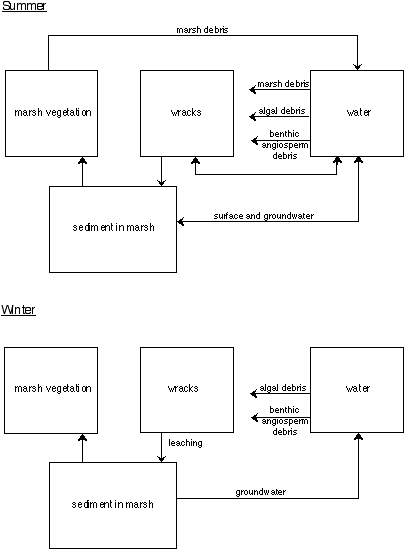
At no time was debris from the marshes observed floating in the estuary, but the presence of large amounts of Cladophora washed up on the shores of the estuary, and large amounts of plant debris at the high water mark, demonstrates transport by water both within and without the marsh, with associated rapid redeposition in wracks through wind effects. The wracks of plant material remain as water levels fall. They would release nutrients through decay, and it is useful to recall that the wracks include not only marsh-derived plant material, but also algae (especially Cladophora), and the benthic angiosperms Ruppia and Halophila. All this material would be transported by wind-induced currents to the shore.
As part of the nutrients required by Scirpus plants must be taken up from the substratum after corm dormancy breaks in spring, the remainder must be redeployed from the corms. Sarcocornia also probably grows in summer, and presumably takes up most of its nutrients during the growth period.
In an estuary undisturbed by man there would be large year to year changes in salinity and nutrients in an area with erratic rainfall, but over the longer term one must assume a reasonable degree of stability in the fringing plant communities. (In the very long term there may be some successional changes, brought about for example by encroachment of the fringing marshes into what was once open water). It follows that, on average, the annual input of nutrients balances the exports; if this were not so, the vegetation would not be in equilibrium with the environment. ('Inputs' here would include N-fixation; and 'exports' would include the permanent deposition of unavailable forms of nutrients in sediments). Speculative flows for the ecosystem are given in Figure 4.1.
With cultural eutrophication, the size of the nutrient bank deposited in the vegetation has increased, largely through the growth and deposition of massive amounts of macro algae, In some regions the amount of material has smothered and killed fringing vegetation, (Backshall, 1977), producing, for example, 'rotten spots' in the Sarcocornia marsh.
The decay of the deposited material must have led to increased nutrient availability, and so no doubt to increased plant growth, which would incorporate some of the extra nutrients and recycle them within the marsh. The measurements made for this study are therefore presumably from an ‘enriched' marsh. It is perhaps worth noting that the biomass of Sarcocornia and Scirpus is high compared to the other very few data available, and Scirpus appears to have expanded recently in the area; whether these effects are related in any way to the eutrophication remains a matter for speculation.
The total marsh area, of 12.8 km2, is not large by world standards, but is significant in view of the general paucity of wetlands in the State. It would be useful to assemble more information about the general significance of the marshes to the ecology of the Peel-Harvey system, for example to bird life and in reducing shore erosion, to allow informed management decisions to be made in the future. At present the marshes are disturbed by the addition of plant material (especially algal detritis) from the open water, and by the rapid spread of Scirpus.
The marshes comprise a small but significant part of the nutrient bank of the whole ecosystem. The size of this nutrient pool might be increased if different species were present - for example, plants with a higher biomass and a greater carryover of plant material from year to year - though the deliberate introduction of species which might trap nutrients would have to be considered very carefully, because of other possible environmental repercussions. The size of the nutrient pool in the marsh would also be increased if the area of marsh were increased. Conversely, destruction of the marshes would reduce the nutrient pool and might transfer nutrients to the open water.
A reduction in the amount of plant material driven into the marsh from the open water could improve the status of the marsh.
1. The total area of the marshes of the System is about 12.8 km2, representing 10% of the marsh plus open water.
2. The marshes represent about 5 to 20% of the nitrogen and phosphorus contents of the estuarine system, apart from sediments.
3. The standing crops of Sarcocornia and Scirpus are relatively high, at least in the few samples taken.
4. The marshes are typically inundated for a high proportion of the year, but especially in winter.
5. Large wracks of decaying marsh vegetation, algae and benthic angiosperms are driven into the marsh; there is apparently no export of plant material, though this is shifted within the marsh.
6. Decay of plant material releases nutrients for marsh growth, and is probably in part returned to the open water.
7. Scirpus has recently expanded in area, replacing Juncus kraussii as a dominant in the marshes of the Harvey River delta.
1. It would be useful to have a better understanding of the possible significance of the marshes to the general ecology of the area, including the bird life, and role in shoreline stabilisation.
2. It would be interesting to have more information about decay and release of nutrients from these wetland plants, probably at the accurately-surveyed transect line. Any such studies should be coupled with an investigation of phenology (seasonality of plant growth and development).
3. A reduction of the trend towards eutrophication in the estuarine system would reduce the impact on the marsh of large amounts of decaying plant material.
| Pool |
Date |
Nitrogen |
Phosphorus |
||
| Tonnes |
% |
Tonnes |
% |
||
| Marshes |
February 1980 |
327 |
33 |
47.8 |
38 |
| Water |
March 1978 |
120 |
12 |
15.02 |
12 |
| Cladophora |
March 1978 |
538 |
55 |
61.4 |
50 |
| Total |
March 1978 |
985 |
100 |
124.2 |
100 |
| Marshes |
February 1980 |
327 |
21 |
47.8 |
24 |
| Water |
August 1978 |
297 |
20 |
47.6 |
24 |
| Cladophora |
August 1978 |
903 |
59 |
103.0 |
52 |
| Total |
August 1978 |
1,527 |
100 |
198.0 |
100 |
| Sediment |
March 1978 |
2,570 |
236.0 |
||
| (Upper 2 cm) |
August 1978 |
2,590 |
271.0 |
||
| 1 These are very approximate figures. The amount of nutrients in the fringing vegetation is assumed to be the same for summer and winter for these calculations, and the estimate for above- and below-ground material has been used. Data are based on dense stands and are therefore overestimated by up to about four times. 2 Estimate only at this stage. |
|||||
Figure 4.1: Flow diagrams for nitrogen and phosphorus.

